Marietta Public Schools is capitalizing on a teacher prep program that’s fairly new, but it
makes so much sense, many wonder why it hasn’t been around longer.
Traditionally, teacher training programs have required that prospective educators obtain a
bachelor’s degree, preferably in education. In addition to taking years to complete, the
degree costs thousands of dollars, and at its conclusion, passing a handful of certification
tests is necessary before certification may be obtained. It’s physically and finically draining,
no doubt about it – and that’s before the teaching ever begins.
It’s not until the end of the process that the teaching candidate enters a classroom, and
sadly, often discovers that nothing they learned in college is applicable in their real world
classroom. Statistics show that many new teachers won’t make it to the five-year mark, not
to mention an entire career in education, a tremendous waste of time and money.
The new program, a nationally recognized model that’s been in existence only since 2022,
seeks to look at teacher training as a registered apprenticeship like many other
professions. Doing teacher prep this way allows prospective educators to get some
education and experience, go into a job and apply a skill set, learn as they go, and finish a
degree as they work in the field.
It’s a hands-on model, so there’s no shock when a teacher hits the classroom for the first
time. It’s more cohesive and connective.
The program is called PACT, or Paraprofessional and Adjunct to Certified Teacher, and is
being administered through Murray State College. Program Director Amanda Younts has
more than 20 years of experience in public education and believes that PACT could not
only put a dent in the teacher shortages but also increase the knowledge and the skill of
teachers.
Marietta Superintendent Brandi Naylor, quickly jumped at the chance to participate.
“When I heard just a little about this program, I was immediately ready to get on board,”
said Naylor. “I knew we had some awesome educators already employed with us that
would qualify and make the most of all the benefits.”
Many veteran public school teachers can attest that paraprofessionals – sometimes called
teachers’ aides – are invaluable in the classroom. Paras often have tons of experience, but
for some reason, traditional college wasn’t in the cards for them. PACT can turn that
around.
“We have so many paras who have been doing the job for a long time, and they know and
understand the job,” Younts said. “They may be doing the same work as a teacher but
can’t quit working and go to school to become a teacher. Because our program is grant-
funded, we have a lot of help for them. Our goal is to bring school to them, and not to leave
them with a lot of debt.”
Because of recent changes in state law, schools can often offer adjunct positions to people
who have life experience but may not have a college degree. PACT can help those people
get into the classroom and bridge the gap between valuable experience and teacher
certification.
“In our initial cohort group, we surveyed superintendents and they said, ‘We have adjuncts
and paras, but they need some help getting their degrees and certification,’ so we started
with that pool of candidates,” Younts explained. “Our next layer would be reaching out to
people who might like to go into teaching but aren’t in school systems now – maybe private
preschools or daycare centers.”
From there, Younts would like to partner with vo-tech centers to allow high school seniors
to get some basic coursework, then spend time in public schools being mentored by
veteran teachers so they can see what teaching is really about. This would allow them to
“try on” the teaching profession before they invest in a college degree.
“If they’re interested, then we have that pipeline in place,” Younts said, “and the school
districts would be able to hire them as paras.”
It would seem that the sky is the limit for the PACT program.
Students in the current cohort program will finish with a bachelor’s degree. PACT is
partnering with some four-year colleges in the state to provide the necessary upper level
coursework. Although recent changes in state law allow community colleges, like MSC, to
offer a bachelor’s degree, the infrastructure for that degree plan isn’t in place at Murray,
although it is a program goal.
In addition to the other services provided by PACT, the program provides help navigating
the Oklahoma State Department of Education’s rules and regulations, things like figuring
out which courses and certifications are necessary, making the certification process less
intimidating and more accessible.
Younts believes that the PACT program has the potential to reduce the teacher shortage,
but even more importantly, to improve the retention rate.
“We hear a lot about recruiting new teachers, but not much about keeping teachers,”
stated Younts, “but statistics show us that people who enter teaching through emergency
certification don’t stay in the profession. This program could change that because people
will know what they’re getting into and have the support they need to stay.”
The cohort has 23 members. Weekly, Younts spends one night each week with members
in schools in Marietta, Pauls Valley, Davis, and Ardmore. Currently, three Marietta
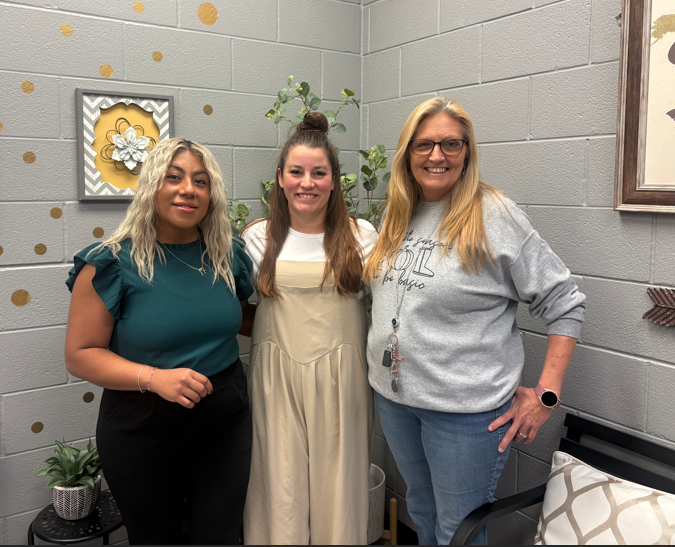
employees – Brittany Presley, Dorothy Berry, and Maria Juanez – are in the program.
However, both Naylor and Younts expect that number to grow.
“College coursework has changed, we’ve lost the human connection,” Youngs commented.
“I know the people I’m working with, and they love the human connection. They like
coming once a week and having time face-to-face with someone who is helping to guide
them. It’s reassuring and encouraging for them, and it’s rewarding for me to help them, to
take the intimidation out of the process, and to be their advocate.”
To cohort members, PACT makes their goal of being a certified teacher one that’s
attainable. For Naylor, who’s watched the teacher shortage progress and, at times,
struggled with staffing, PACT is a chance to actually do something to rectify the situation,
rather than watch it continue to worsen.
“For us, this is more than just a teacher training program,” Naylor said. “It’s an investment
in our district. Our hope is that the people in this cohort – some of whom are Marietta
graduates and residents – become qualified professional educators, and that they continue
to work in our district and spend their entire teaching careers here at Marietta.”